Board books for babies and toddlers: how to choose
Board books are often a child's very first books. They are built to be chewed, dropped and loved. Here is how to pick good ones for each stage from birth to age three.
On this page
Board books are made of thick, sturdy cardboard pages that babies and toddlers can grab, turn, chew and drop without tearing. They are usually a child's first books, and they play a big role in early language and bonding. This guide explains what to look for at each age, which kinds of board books work best, and how to read them with a very young child.
Why board books matter
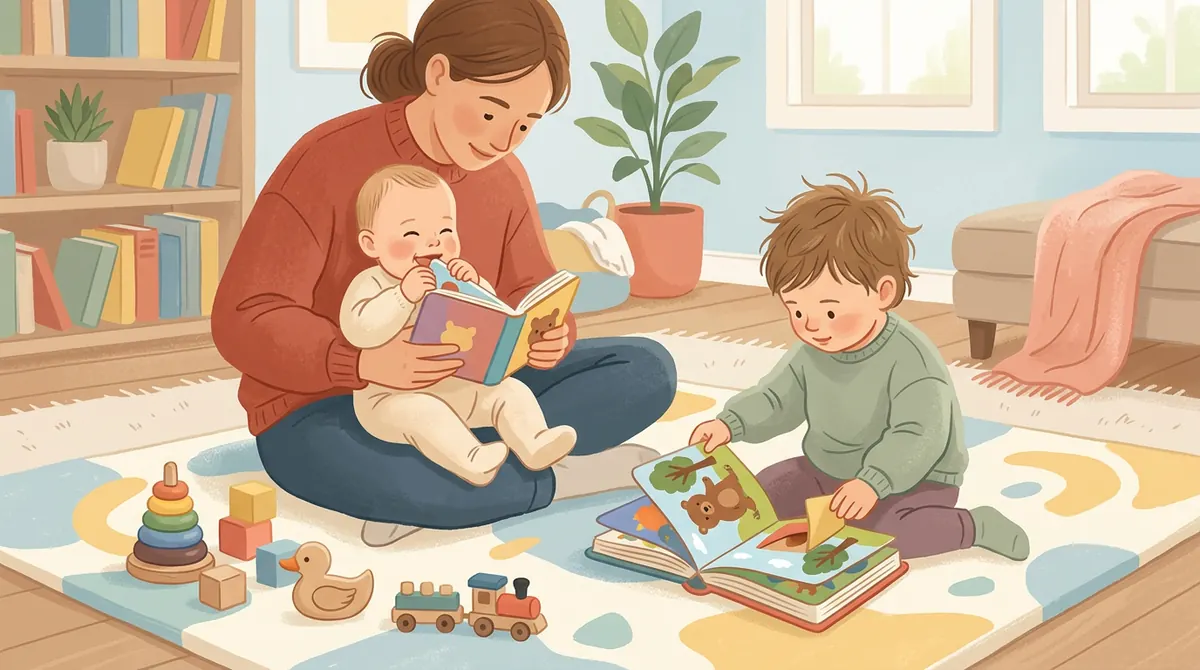
Reading with babies and toddlers helps them hear lots of words, learn that pictures stand for real things, and connect books with cuddles and attention. The American Academy of Pediatrics encourages parents to read aloud with children starting in infancy. Board books are made for this stage because little hands cannot yet turn thin paper pages without tearing them.
What to look for at each age
Newborn to 6 months
Babies this young see best up close and are drawn to strong contrast.
- High-contrast books with bold black, white and bright shapes.
- Faces. Babies love looking at faces, especially other babies.
- Soft or fold-out books that can stand up during tummy time.
At this age, the sound of your voice matters more than the story. You can simply talk about the pictures.
6 to 12 months
Babies start grabbing, shaking and chewing everything, including books.
- Very sturdy board books with rounded corners.
- Simple pictures of single objects: a ball, a dog, a cup.
- Touch-and-feel books with different textures.
- Rhythm and rhyme. Books with a bouncy rhythm are fun to read aloud.
12 to 24 months
Toddlers begin to point, name things and turn pages on their own.
- Lift-the-flap books with sturdy flaps.
- Word books with labeled pictures of everyday things.
- Simple stories with one line per page.
- Animal sounds and actions they can copy.
2 to 3 years
Older toddlers enjoy short stories and repeated phrases.
- Repetitive, predictable text they can say along with you.
- Concept books about colors, numbers, shapes and opposites.
- Everyday routines, such as bath time, bedtime and potty training.
- Board book versions of picture books with slightly longer stories.
Classic board books many families love
You probably know some of these from your own childhood. They are widely available in board book editions:
- Goodnight Moon by Margaret Wise Brown, illustrated by Clement Hurd
- Brown Bear, Brown Bear, What Do You See? by Bill Martin Jr., illustrated by Eric Carle
- The Very Hungry Caterpillar by Eric Carle
- Where's Spot? by Eric Hill
- Dear Zoo by Rod Campbell
- Pat the Bunny by Dorothy Kunhardt
For more ideas by age, see the best books for kids by age.
Safety tips
- Check flaps and pieces. Make sure flaps are firmly attached and there are no small parts that could come loose.
- Avoid books with buttons or batteries for babies who mouth everything, unless the battery compartment is securely closed with a screw.
- Wipe them clean. A slightly damp cloth cleans most board books. Do not soak them.
- Retire damaged books. Peeling layers or loose bits can become choking hazards.
How to read with a baby or toddler
- Hold your child close so they can see the pictures and feel your warmth.
- Talk, do not just read. Point to pictures and name them. "Look, a red ball!"
- Use your voice. Make animal sounds, sing, and change your tone.
- Let them explore. It is fine if they turn pages out of order, chew the corner or only look at one page.
- Follow their lead. Stop when they lose interest and try again later.
- Read the same books again and again. Repetition helps babies learn.
Where to find board books
Board books can be expensive new, but there are many ways to save:
- Library. Most libraries have a baby and toddler section with board books to borrow.
- Free programs. Dolly Parton's Imagination Library mails free books to children from birth to age five in participating areas, and PJ Library sends free Jewish books in many communities.
- Used books. Board books survive well, so used copies from thrift stores and library sales are a great deal. Wipe them clean first.
- Gifts. Board books make wonderful baby shower gifts. See our book gift guide.
More money-saving ideas are in how to save money on books.
Building the collection
You do not need many. Ten to twenty good board books are plenty for a baby or toddler. Keep them in a low basket so your child can reach them, and swap some out every few weeks. As your child grows, the basket will become the start of a home library.
Questions
What age are board books for?
Board books are made for babies and toddlers from birth to about age three, when little hands are not yet ready for thin paper pages.
When should I start reading to my baby?
You can start from birth. Young babies enjoy hearing your voice and looking at bold, high-contrast pictures.
Are used board books safe?
Usually yes, if they are in good condition. Check that pages are not peeling and flaps are secure, then wipe them clean with a damp cloth.
How many board books does a baby need?
Ten to twenty good board books are plenty. Babies love repetition, so a small collection read often is better than a big one.
Sources
Checked November 20, 2026.