How to help a reluctant reader enjoy books
Some children love books from the start. Others need a little help finding the kind of reading that clicks for them. Here is how to help without turning reading into a fight.
On this page
"Reading is boring." If you have heard that from your child, you are not alone. Many children go through phases where they would rather do almost anything else. The good news is that most reluctant readers are not anti-reading. They just have not found the right books, the right format or the right reason yet. These ideas can help.
First, figure out why
Children avoid reading for different reasons, and the fix depends on the reason.
- The books are too hard. If a child struggles with many words on a page, reading feels like work, not fun.
- The books are not interesting. A child who loves trucks or soccer may not care about the books on the class list.
- Reading feels like a test. If every reading moment comes with questions or a timer, children can start to dread it.
- Other things are more exciting. Screens and games are fast and bright. Books need a little more patience.
- A learning difference. Some children find reading hard because of dyslexia or vision problems. More on that below.
Watch your child read for a few minutes and talk with their teacher. You will often get a good clue.
Let them choose
Choice is one of the most powerful tools you have. Children read more when they pick their own books, even if the choices are not what you would pick. Take them to the library or a bookstore and let them browse freely. Joke books, fact books, sports books, comics and books based on their favorite shows all count.
Follow their interests
Find books about what your child already loves:
- Animals, sharks or dinosaurs: fact books with big photos.
- Sports: biographies of athletes, sports stories or rule books.
- Video games: game guides, books set in game worlds or adventure stories.
- Building and making: craft books, science experiment books and how-to guides.
- Funny stuff: joke books, silly poems and humor series.
Nonfiction is often the key for reluctant readers. Many kids who "hate reading" will happily read about volcanoes for an hour.
Graphic novels count
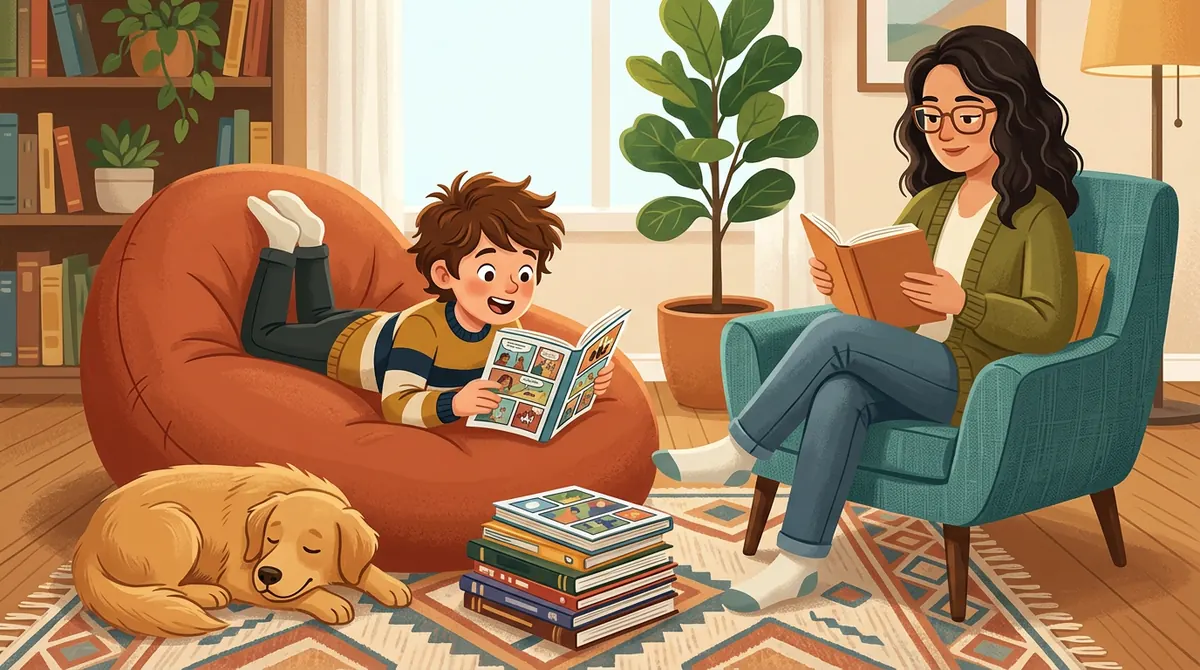
Some parents worry that graphic novels and comics are not "real" reading. They are. Children still decode words, follow a story and learn vocabulary, and the pictures help them understand what is happening. Many librarians recommend graphic novels for reluctant readers. They are often a bridge to longer chapter books.
Make it easier
- Try books a little below their level. Easy, fun reading builds confidence and speed.
- Look for short chapters. Finishing a chapter feels like a win.
- Series are great. Once a child likes the characters, they want to read the next book.
- High-interest, lower-level books. Some publishers make books with exciting stories and easier words for older children who are still building skills. Ask your librarian.
Read together
Reading aloud is not just for little kids. Reading a chapter book together, taking turns reading pages, or reading the same book at the same time and talking about it can make reading feel social instead of lonely. You read the hard parts, they read the easier parts.
Audiobooks are reading too
Listening to audiobooks builds vocabulary, comprehension and a love of stories. Some children like to follow along in the printed book while they listen, which can help with reading too. Many libraries lend audiobooks for free through apps such as Libby. Our ebook side explains audiobooks vs ebooks.
Take away the pressure
- Do not use reading as a punishment. "No video games until you read for 20 minutes" can make reading feel like a chore.
- Skip the quiz. Ask "What was your favorite part?" instead of testing them.
- Let them quit a book. Adults put down books they do not like. Kids can too.
- Celebrate all reading. Recipes, cereal boxes, game instructions and signs all count.
Be a reading role model
Children notice what grown-ups do. Let them see you read books, newspapers or magazines for fun. Talk about what you are reading. Make a family reading time where everyone reads their own thing together, even for 15 minutes.
Make reading part of everyday life
- Keep books in the car, in the bathroom and by the bed.
- Visit the library regularly and make it a fun outing.
- Give books as gifts and let your child choose them.
- Set up a cozy home library corner.
When to ask for help
If your child seems to struggle much more than other children their age, avoids reading out loud, mixes up letters often after first grade, or complains of headaches or blurry words, talk with their teacher and pediatrician. An eye exam can rule out vision problems, and a school or specialist can check for learning differences like dyslexia. Early help makes a big difference, and many children who struggle at first go on to love reading.
Questions
Do graphic novels count as reading?
Yes. Children still read the words, follow a story and learn vocabulary, and the pictures support understanding. Many librarians recommend graphic novels for reluctant readers.
Should I make my child read for a set time every day?
A regular reading time can help, but avoid making it a punishment. Letting your child choose what to read and keeping the mood relaxed works better than strict rules.
Are audiobooks cheating?
No. Audiobooks build vocabulary, comprehension and a love of stories. Following along in the printed book can also support reading skills.
When should I worry about my child's reading?
If your child struggles much more than classmates, avoids reading aloud, or has trouble with letters and sounds, talk with their teacher and pediatrician. An eye exam and a reading assessment can help.
Sources
Checked November 20, 2026.